
Why Is My BMW or Mercedes Losing Power on the Highway? What Alpharetta Drivers Should Know About Fuel System Issues
If your BMW or Mercedes-Benz feels like it’s running out of steam during highway acceleration — hesitating, surging, or just refusing to respond the way it used to — you’re not imagining it, and it’s not normal. For Alpharetta drivers who spend time on GA-400 commuting into Atlanta or making runs up toward Milton and Johns Creek, that kind of power loss isn’t just annoying. It’s a warning sign that something in your fuel system needs attention. The good news: caught early, most fuel system problems are straightforward to fix. Left alone, they can lead to much bigger and more expensive engine damage.
What Does a Fuel System Problem Actually Feel Like?
European engines are precision instruments. BMW’s twin-turbocharged inline-six and V8 platforms, along with Mercedes-Benz’s AMG-tuned and standard turbocharged engines, all rely on fuel being delivered at exactly the right pressure and at exactly the right moment. When something in that system starts to fail, the feedback is usually subtle at first — and then progressively worse.
Here’s what to watch for:
- Hesitation or stumble during hard acceleration — especially when merging onto the highway or passing
- A surge or shudder at steady highway speeds — the engine feels like it’s hunting for the right fuel mixture
- Sluggish throttle response after sitting in stop-and-go traffic, then opening up on the highway
- Rough idle that smooths out at speed — or the reverse, rough running only under load
- A noticeable drop in fuel economy alongside the power loss
- A check engine light with misfires or lean/rich condition codes
Any one of these symptoms in isolation warrants a diagnostic scan. Several together almost certainly point to the fuel system.
The Most Common Fuel System Failures in BMWs and Mercedes-Benz Vehicles
High-Pressure Fuel Pump (HPFP) Failure
This is arguably the most well-known fuel system issue for BMW owners, particularly those with the N54 and N55 turbocharged engines found in the 335i, 535i, 135i, and several X-series models. The high-pressure fuel pump is responsible for delivering fuel to the direct injection system at the pressures these engines demand — sometimes exceeding 2,000 PSI. When the HPFP begins to wear, it can’t maintain those pressures consistently, and the engine’s fuel trims go haywire trying to compensate.
Mercedes-Benz turbocharged engines, including those in the C300, E350, GLC, and AMG variants, have their own high-pressure pump architecture. Failure symptoms are similar: hard starts, power loss under load, and fault codes related to fuel pressure or quantity control.
This is not a DIY repair. High-pressure fuel system components require precise installation and fuel system flushing procedures. Using non-OEM parts here is a mistake — the tolerances involved demand factory-quality components.
Clogged or Fouled Fuel Injectors
Direct-injected European engines — and that includes nearly every modern BMW and Mercedes — spray fuel directly into the combustion chamber rather than into the intake port. This is more efficient and powerful, but it comes with a known trade-off: carbon buildup on the intake valves and injector tips. Over time, partially clogged injectors deliver an inconsistent fuel spray pattern, leading to misfires, rough running, and the kind of hesitation that becomes very noticeable on a long highway stretch.
Professional injector cleaning or replacement using OEM or equivalent-quality injectors restores the spray pattern and eliminates the rough behavior. Some shops skip this in favor of over-the-counter fuel system additives — those rarely solve an actual injector fouling problem on a European direct-injection engine.
Fuel Pressure Regulator and Low-Pressure Feed Issues
Before fuel even reaches the high-pressure pump, it travels from the tank through a low-pressure fuel delivery system. A failing in-tank pump, a degraded fuel pressure regulator, or a partially blocked fuel filter (on vehicles where the filter is serviceable) can starve the HPFP of the supply it needs. This is more common on higher-mileage vehicles and is often overlooked because technicians jump straight to the high-pressure side without checking the supply pressure first.
Thorough fuel system diagnosis means checking the entire circuit — not just the component that threw a code.
Why This Problem Gets Worse in Georgia Heat
North Fulton County summers are brutal on fuel systems. High ambient temperatures raise fuel temperatures inside the tank and fuel lines, which can cause vapor formation and inconsistent fuel delivery — a phenomenon called vapor lock in its extreme form. More commonly, heat accelerates degradation of fuel pump components, o-rings, and seals. If your BMW or Mercedes started developing this power loss problem after a particularly hot stretch of weather, that’s not a coincidence.
The stop-and-go traffic on GA-400 through Alpharetta and into Roswell also creates a specific stress pattern: the engine sits at idle burning rich during traffic, then gets asked for maximum fuel delivery the moment the highway opens up. For a fuel system that’s already marginal, that transition is when the symptom becomes undeniable.
What Competitor Shops Often Miss: Full-System Fuel Diagnostics
This is where the difference between a genuine European specialist and a general repair shop becomes clear. Many shops — including some in the Alpharetta and Roswell corridor — will pull fault codes, see a fuel pressure or misfire code, replace the most obvious failed component, and call it done. If the high-pressure pump throws a code, they replace the pump. If an injector code appears, they clean or swap that injector.
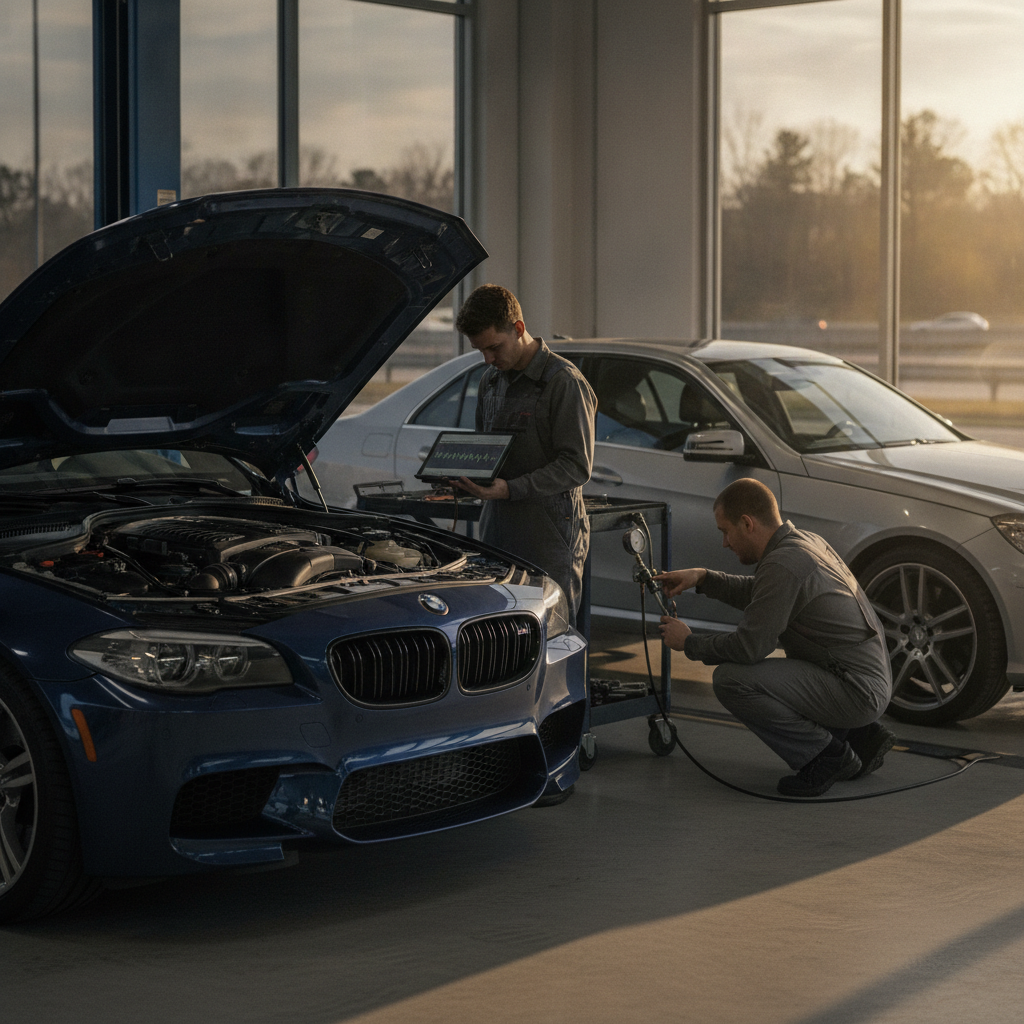
What they often skip is a comprehensive pressure and flow test of the complete fuel delivery circuit — from the tank pump to the rail pressure at the injectors — under real operating conditions. That’s what separates a proper repair from one that comes back in six months. At Solo Motor Sports, our technicians use dealership-level diagnostic equipment to map actual fuel pressure behavior across the full operating range of your engine, not just at idle in the bay. That’s how you find the root cause, not just the symptom. You can learn more about our repair approach and services here.
What to Ask Before You Authorize a Fuel System Repair
Whether you’re coming to us or evaluating another shop, these are the right questions to ask:
- Did you test low-side and high-side fuel pressure independently, or just pull codes?
- Are you using OEM or OEM-equivalent parts for the pump and injectors?
- Will you perform a fuel system flush as part of the repair?
- Is there a warranty on the parts and labor?
- Will you check for carbon buildup on the intake valves while you’re in there?
Any specialist worth your business should answer all five of those without hesitation.
Frequently Asked Questions
How much does it cost to replace a high-pressure fuel pump on a BMW or Mercedes?
The cost varies significantly by model and generation, and you should be cautious of any shop quoting a flat price before they’ve diagnosed which component has actually failed. What we can tell you is that using OEM or factory-equivalent parts matters here — cheap aftermarket HPFPs fail early and can damage the entire fuel rail. Ask for a diagnostic before any quote.
Will a fuel system cleaner from the auto parts store fix this?
Almost certainly not for a BMW or Mercedes with an actual fuel system fault. Over-the-counter additives can help with mild injector deposits as a preventive measure, but they don’t restore pump pressure, fix worn regulators, or address carbon buildup on direct-injection intake valves. If you’re already experiencing symptoms, you need a hands-on diagnosis.
Can I still drive my BMW if it’s losing power on the highway?
You can in most cases, but you shouldn’t ignore it or assume it will resolve on its own. A lean condition caused by insufficient fuel delivery can damage catalytic converters over time. A failing HPFP can also leave you stranded if the failure progresses. Get it looked at sooner rather than later.
My Mercedes-Benz AMG is the one with the power loss — is this more complicated to diagnose?
AMG engines are high-performance variants with specific fuel delivery requirements that exceed those of standard Mercedes models. Diagnosis and repair require technicians who understand those specifications and have access to Mercedes factory-level diagnostic tools. A generalist shop with a generic scan tool will likely misdiagnose or miss secondary contributing factors.
Does fuel quality affect this? I’ve been using 87 octane to save money.
Yes — significantly. BMW and Mercedes turbocharged engines are engineered for 91 octane minimum, and many AMG and performance variants require 93. Running lower-octane fuel causes the engine management system to retard timing to prevent knock, which directly reduces power output. It can also leave deposits in the fuel system and combustion chamber more quickly. Always run the grade specified in your owner’s manual or fuel door placard.
Get a Real Fuel System Diagnosis — Not Just a Code Read
If your BMW or Mercedes is losing power on the highway and you’re in Alpharetta, Johns Creek, Milton, or the Roswell area, Solo Motor Sports is the specialist shop built for exactly this kind of problem. Our engine repair and diagnostics team uses factory-level equipment and OEM-quality parts to trace fuel system problems to their actual source — not just the code that triggered the check engine light. Every repair comes with a warranty, and we give you honest answers before we start any work.
Don’t let a fuel system issue turn into a bigger engine problem. Contact Solo Motor Sports today to schedule a diagnostic appointment. We’re located at 11702 Alpharetta Hwy in Roswell, conveniently accessible for drivers throughout North Fulton County. Call us at (470) 282-1238 or reach out online — we’ll tell you exactly what’s going on and what it takes to fix it right.