
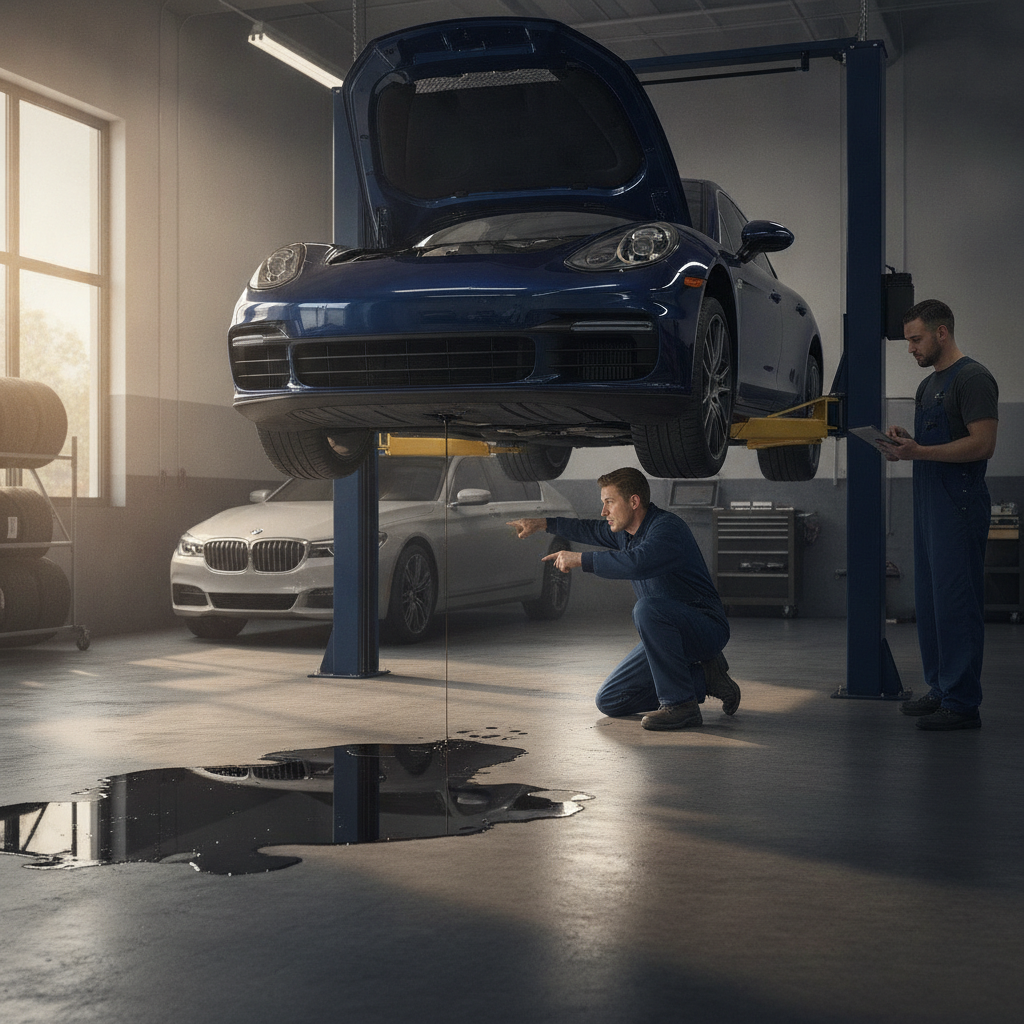
Why Is My Porsche Panamera or BMW 7 Series Leaking Oil? What Roswell Owners Should Know
If you’ve noticed a dark spot forming under your Porsche Panamera or BMW 7 Series in your driveway — or caught a faint burning smell after a run up GA-400 — you’re not imagining things. Oil leaks on both of these vehicles are one of the most common issues we diagnose at Solo Motor Sports in Roswell, and while neither the Panamera nor the 7 Series is fragile by any measure, both use precision-engineered engines that are genuinely unforgiving when a seal or gasket starts to fail. The good news: caught early, most oil leaks are a manageable repair. Left alone — especially through a Georgia summer — they become engine damage you don’t want to price out.
What Actually Causes Oil Leaks in a Porsche Panamera or BMW 7 Series?
These are not the same vehicle, but they share a common reality: both use sophisticated, high-output engines packed into tight bays with complex sealing systems. When those seals age or are exposed to sustained heat cycles — exactly the kind of stress that stop-and-go Atlanta metro traffic produces — they shrink, harden, and eventually crack.
On the Porsche Panamera, the most frequent culprits are the valve cover gaskets, the oil separator (crankcase ventilation) system, and the rear main seal. The 3.0-liter turbocharged V6 and the 4.0-liter twin-turbo V8 variants are both known to develop valve cover leaks as mileage builds, particularly in vehicles that have seen extended oil change intervals or heavy use. The oil separator on the Panamera is a component that many general shops don’t even think to inspect — it fails quietly and can cause oil consumption and pressure issues that look like something more expensive.
On the BMW 7 Series — whether you’re driving an 740i, 750i, or the M760i — oil leak patterns are well-documented. The valve cover gaskets are a known weak point on the N63 and B58 engine families. The oil pan gasket is another high-frequency failure, and given how low the 7 Series sits, even a modest leak creates an immediate risk. The transfer case and differential seals on xDrive models are also worth monitoring. Any of these can start as a slow seep that you only notice after parking — and then accelerate quickly once the seal begins to open further.
Why Georgia Heat and Metro Traffic Make This Worse
North Fulton County is genuinely hard on European vehicles in ways that don’t get discussed enough. The combination of summer heat — sustained temperatures above 95°F through July and August — and the constant thermal cycling that comes from sitting in traffic on GA-400 or 400-connector routes between Roswell, Alpharetta, Milton, and Johns Creek puts seals through repeated expansion and contraction that accelerates wear faster than highway-only driving would.
Rubber gaskets and seals have a service life, and that life shortens significantly when an engine is frequently brought up to operating temperature and then left to heat-soak in a parking lot. If you drive your Panamera or 7 Series to work in Sandy Springs or downtown Atlanta five days a week, that thermal stress is real and cumulative. It’s one reason we see oil leak complaints spike in late summer at our shop — owners notice the smell or the spot after months of slow deterioration that finally crosses a visible threshold.
The Signs You Shouldn’t Wait On
Some oil leaks are slow enough that your vehicle’s oil level stays within range between changes. Others are not. Here’s what to watch for:
- A dark spot or puddle under the engine bay after the car has been parked overnight — even a small one
- A burning oil smell from the engine compartment during or after driving, especially at highway speeds
- Oil level dropping between services without visible external leakage (this can indicate an internal seal or the crankcase ventilation system)
- Blue-tinged smoke from the exhaust on startup or under acceleration — a sign oil is reaching combustion
- An oil pressure warning on your instrument cluster — this is serious and warrants stopping immediately
On a Panamera or 7 Series, ignoring any of these signs long enough will move the conversation from a gasket replacement to a discussion about engine wear, catalytic converter damage from oil contamination, or — in worst-case scenarios — a seized engine. The repair costs escalate dramatically at each stage.
What Diagnostics Actually Involve (And Why a Specialist Matters Here)
This is the section that most competitor sites in the Roswell and Alpharetta area gloss over: oil leak diagnosis on a Porsche Panamera or BMW 7 Series is not a simple visual inspection. Both vehicles require specific factory-level diagnostic tools to access the oil system data, interpret pressure readings, and identify whether the leak source is primary or whether multiple seals are involved.
At Solo Motor Sports, we use dealer-equivalent diagnostic equipment to read the full picture before we recommend a repair path. That matters because misidentifying the leak source — replacing a valve cover gasket when the real issue is the crankcase ventilation system, for example — leads to repeat visits and unnecessary labor charges. You deserve to know exactly what’s leaking, why, and what the fix costs before anyone touches your engine.
We also use OEM-spec gaskets and seals on every repair. On a Panamera or 7 Series, aftermarket gasket quality varies enormously, and a cheap replacement seal on a high-pressure, high-temperature engine is a false economy. If a seal fails again six months after installation, the labor cost to get back in there is identical — you’ve just paid it twice.
What to Expect in Terms of Repair Scope and Timeline
Valve cover gasket replacements on both the Panamera and 7 Series are typically same-day repairs at a specialist shop with the right tooling — usually a half-day to a full day of labor depending on engine configuration. Oil pan gasket replacements take longer given the access required, and rear main seals are a more involved job that may require the transmission to be supported or partially dropped.
For an honest estimate specific to your vehicle, mileage, and leak location, our engine repair team can give you a clear picture after a proper diagnosis — no guesswork, no inflated estimates designed to match what the dealership down the road would charge.
Frequently Asked Questions
Is it safe to drive my Porsche Panamera or BMW 7 Series if it’s leaking oil?
It depends on the rate of the leak. A slow seep that doesn’t affect oil level between services is lower risk in the short term, but you should still have it diagnosed promptly. If the oil level is dropping noticeably, or if you see an oil pressure warning, stop driving and have the vehicle towed — running a luxury engine low on oil can cause catastrophic damage within minutes.
Why does my 7 Series smell like burning oil even though there’s no puddle under the car?
This is a classic sign of a valve cover gasket leak that’s dripping oil onto the exhaust manifold rather than onto the ground. The oil burns off before it hits the floor, which is why you smell it but don’t see it. It still needs attention — oil on an exhaust manifold is also a fire risk.
How often do Porsche Panamera oil seals typically need replacement?
There’s no fixed interval, but most Panameras begin showing gasket wear between 60,000 and 100,000 miles, especially in climates with significant temperature swings. Regular oil changes using the correct specification oil and not exceeding the recommended interval helps extend seal life meaningfully.
Can I use a stop-leak additive to fix the problem temporarily?
We strongly advise against it on any Porsche or BMW engine. Stop-leak products can swell seals temporarily but often cause downstream problems — clogged oil passages, residue buildup, and incompatibility with the synthetic oils these engines require. The right fix is identifying and replacing the failed component.
Will the dealership repair cost significantly more than an independent specialist?
In most cases, yes — often significantly more. Dealership labor rates in the Atlanta metro area run considerably higher than what a qualified independent specialist charges for the same repair using the same OEM-spec parts. The quality of the work at a shop like Solo Motor Sports is the same; the difference is in the overhead you’re not paying for.
Get Your Porsche or BMW Inspected Before a Slow Leak Becomes a Real Problem
If you’re in Roswell, Alpharetta, Johns Creek, Milton, or Sandy Springs and you’ve noticed any of the signs described above, don’t put it off. Oil leaks on precision European engines don’t resolve on their own — they worsen. The cost of a gasket replacement today is a fraction of what deferred maintenance turns into six months from now.
Solo Motor Sports specializes in Porsche, BMW, and the full range of European and import vehicles. Our technicians have factory-level training, the right diagnostic tools, and a genuine interest in giving you an honest answer — not the most profitable one. Contact us to schedule a diagnostic appointment and let’s find out exactly what’s happening before it gets worse.