
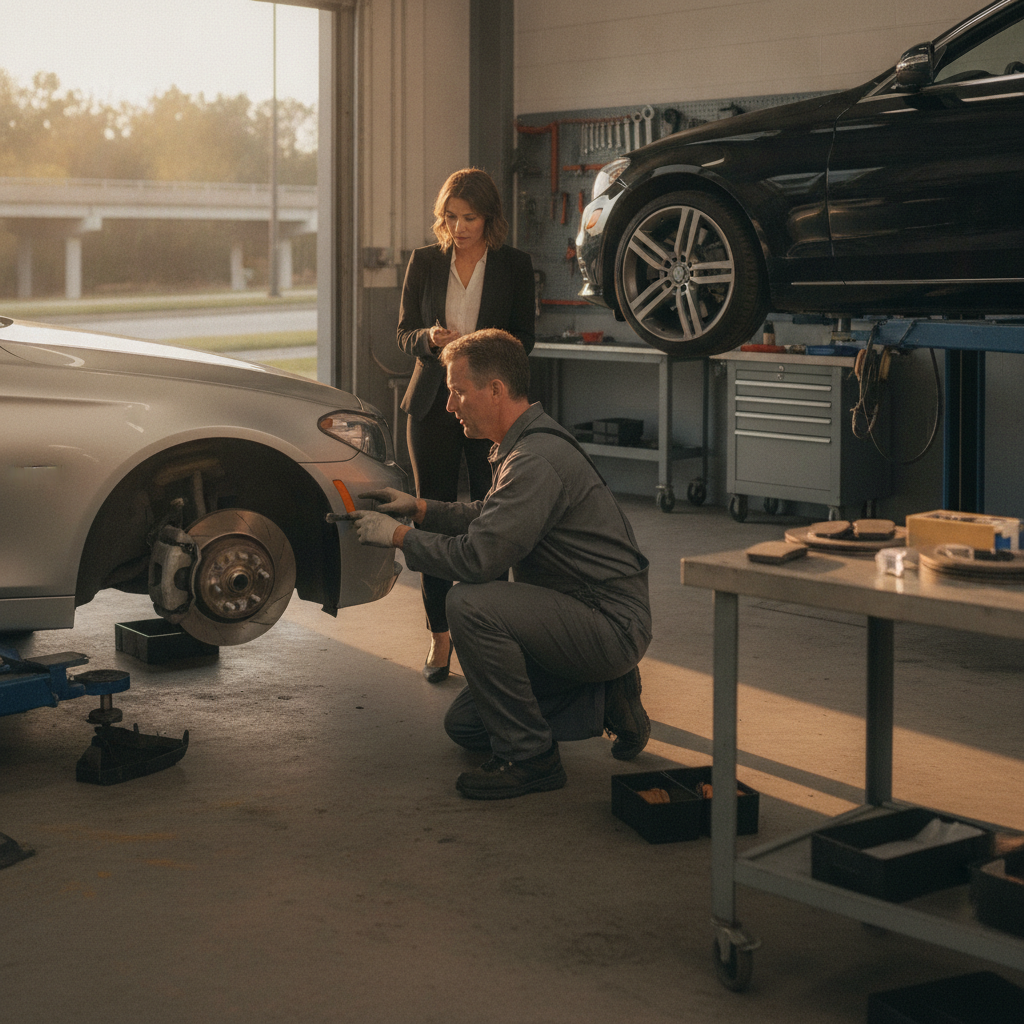
How Do You Know When Your BMW or Mercedes Needs New Brake Pads? What Roswell Owners Should Watch For
Your BMW or Mercedes-Benz will usually tell you when the brakes are wearing down — but only if you know what to listen and feel for. In Roswell and across North Fulton County, where stop-and-go traffic on GA-400 and Alpharetta Highway is a daily reality, brake pads wear faster than most owners expect. The good news is that European vehicles are engineered with early warning systems built in. The bad news is that those warnings are easy to ignore until the problem becomes expensive.
This isn’t a generic brake article. It’s specific to what BMW and Mercedes-Benz owners experience — the way these vehicles communicate brake wear, what a proper service looks like, and what you’re actually paying for when you go to a specialist instead of a dealership or a quick-lube shop.
The Warning Signs BMW and Mercedes Owners Often Miss
Most people know the classic squeal of worn brake pads. But on a BMW 5 Series, a Mercedes E-Class, or a GLE, that squeal may never come — or it may come only briefly before you convince yourself it was nothing. Here’s what to actually pay attention to:
- The brake wear indicator light. BMW and Mercedes both use electronic brake pad sensors that trigger a dashboard warning when pads reach a critical thickness. This is your clearest signal, and it means you have some time — but not unlimited time. Don’t schedule this for “next month.” Schedule it this week.
- A subtle pulsing in the brake pedal. If the pedal vibrates when you apply pressure, that’s usually a warped rotor. On European vehicles, rotors and pads are typically replaced together for this reason — the rotor surface matters as much as the pad compound.
- Pulling to one side under braking. This suggests uneven pad wear, a sticking caliper, or a brake hose that’s deteriorating internally. It’s a safety issue, not a cosmetic one.
- A longer stopping distance than usual. This one is hard to quantify, but if your car doesn’t stop the way it used to — especially in a panic stop — trust that instinct. Reduced braking performance is a real symptom, not driver error.
- Grinding or metal-on-metal scraping. At this point, the pads are gone and you’re cutting into the rotor. What was a pad-and-rotor job is now potentially a caliper job too.
Why European Brake Service Is Different From What a General Shop Does
Here’s what gets glossed over on most competitor sites in the area: brake service on a BMW or Mercedes isn’t just swapping pads. The brake system on these vehicles is integrated with electronic stability control, ABS calibration, and — on many newer models — an electronic parking brake that requires a specific software procedure to retract the rear calipers before service. If a shop doesn’t have the right diagnostic tools, they’re either skipping that step or doing it wrong.
At Solo Motor Sports, our technicians use factory-level diagnostic equipment to perform brake service the way your vehicle was designed to receive it. That includes properly retracting electronic parking brake actuators on models like the BMW 3 Series, 5 Series, X5, Mercedes C-Class, E-Class, and GLE — not forcing the caliper back mechanically, which damages the actuator and creates a problem you’ll pay for later.
It also means using the right friction materials. OEM and OEM-equivalent brake pads are formulated specifically for the braking performance characteristics of your vehicle. Aftermarket economy pads may fit physically, but the bite point, fade resistance, and dust profile are different. On a vehicle calibrated for specific braking behavior, that matters.
Learn more about our brake repair services in Roswell.
How GA-400 and Atlanta Metro Traffic Accelerates Brake Wear
This is something worth understanding if you drive in this area regularly. The stretch of GA-400 between Sandy Springs and Alpharetta — and the surface streets feeding into it from Roswell, Johns Creek, and Milton — involves sustained stop-and-go patterns that heat cycle your brakes repeatedly every single commute. Brake fade isn’t just a track day phenomenon. It happens at highway off-ramps when pads are hot and you’re decelerating hard from 70 mph.
For drivers coming out of neighborhoods like Horseshoe Bend or Martin’s Landing and merging onto the corridor every morning, brake wear happens faster here than the factory interval tables suggest. Checking brake pad depth at every oil service — not just when the light comes on — is a reasonable approach for high-commute vehicles in this area.
What a Proper BMW or Mercedes Brake Inspection Should Cover
When you bring your vehicle to Solo Motor Sports for a brake inspection, we’re not just measuring pad thickness. A complete brake inspection includes:
- Pad thickness measurement on all four corners
- Rotor thickness measurement and runout check (warping)
- Caliper slide pin inspection and lubrication
- Brake fluid condition and moisture content test
- Brake hose inspection for cracking, swelling, or internal restriction
- Electronic brake sensor integrity check
- Parking brake function (electronic or mechanical)
This is part of our multi-point inspection process, which we perform on every vehicle that comes through the shop. You won’t get a vague “brakes look okay” — you’ll get actual measurements and an honest assessment of how much life is left.
Brake Fluid: The Service BMW and Mercedes Owners Routinely Skip
This is the gap that almost no competitor in the Roswell area covers adequately in their content — and it’s one of the most important brake maintenance items on European vehicles.
Brake fluid is hygroscopic, meaning it absorbs moisture from the atmosphere over time. As moisture content increases, the boiling point of the fluid drops. When brake fluid with high moisture content gets hot — which happens constantly in city driving — it can partially vaporize inside the brake lines. That vapor is compressible. Your firm pedal becomes soft. Your braking response becomes unpredictable.
BMW recommends brake fluid replacement every two years regardless of mileage. Mercedes-Benz follows a similar interval. Most owners never do it, because no warning light tells them to and no dealer service advisor pushes it unless they’re upselling a service package. It’s a modest service that has a direct impact on braking safety and caliper longevity. We test brake fluid moisture content as part of every brake inspection at Solo Motor Sports.
What to Expect From Brake Service at Solo Motor Sports
We use OEM-specification brake pads and rotors for BMW and Mercedes-Benz vehicles — the same quality standard your vehicle was designed for. All brake work is backed by a warranty on parts and labor. We’ll walk you through what we found, show you the measurements, and let you make an informed decision. No pressure, no inflated service packages, no surprise add-ons at pickup.
Same-day turnaround is available for most standard brake services. If you’re coming from Alpharetta, Johns Creek, or Sandy Springs, we’re easy to reach just off Alpharetta Highway — and we’ll give you a straight answer about what your vehicle actually needs before any work begins.
Frequently Asked Questions
How long do brake pads typically last on a BMW or Mercedes?
It depends heavily on driving habits and conditions. In stop-and-go Atlanta metro traffic, front pads on a BMW or Mercedes can wear to service limits in as little as 20,000–30,000 miles. Highway-dominant drivers may get 40,000–50,000 miles. Rear pads typically last longer, but the electronic parking brake on many models accelerates rear pad wear if it’s used frequently.
Do I need to replace rotors every time I replace pads?
Not always, but often yes on European vehicles. BMW and Mercedes rotors are engineered to specific minimum thickness tolerances. Once a rotor is machined or worn below that threshold, it can’t dissipate heat effectively. We measure rotor thickness and assess whether resurfacing is appropriate or whether replacement is the safer call — and we’ll explain that clearly before any work is done.
Is it safe to drive on the brake wear indicator light?
You have some time — typically a few hundred miles at most — but don’t treat it as a “schedule it when it’s convenient” situation. The sensor is warning you that the pad is near its wear limit. Continuing to drive means the rotor is next. What’s a pad-and-rotor job now becomes a rotor-and-caliper job if you wait too long.
Can any shop do brake service on my BMW or Mercedes, or does it need to be a specialist?
Technically any shop can replace brake pads, but on vehicles with electronic parking brakes, adaptive cruise control integration, or iDrive/COMAND-linked brake monitoring systems, the service needs to be performed with the right software tools. A shop that doesn’t have BMW or Mercedes diagnostic capability may complete the job incorrectly — which you’ll only discover when the warning light comes back on or the rear calipers are damaged.
How much does BMW or Mercedes brake service cost compared to the dealership?
We don’t publish fixed pricing because brake service varies significantly by model, axle, and parts specification. What we can tell you is that our pricing is consistently lower than dealership rates for the same quality of parts and expertise. Contact us for a quote specific to your vehicle — we’ll give you a straight number with no surprises.
Schedule Your Brake Inspection at Solo Motor Sports
If your BMW or Mercedes-Benz is showing any of the warning signs above — or if you simply can’t remember the last time the brakes were inspected — don’t wait for a bigger problem to develop. Solo Motor Sports serves Roswell, Alpharetta, Johns Creek, Sandy Springs, Milton, and the surrounding North Fulton area with the kind of specialized European brake service that your vehicle was engineered to receive.
Reach out through our contact page to schedule an inspection or ask a question about your specific vehicle. We’ll give you honest answers and get you back on the road with confidence in your brakes.