
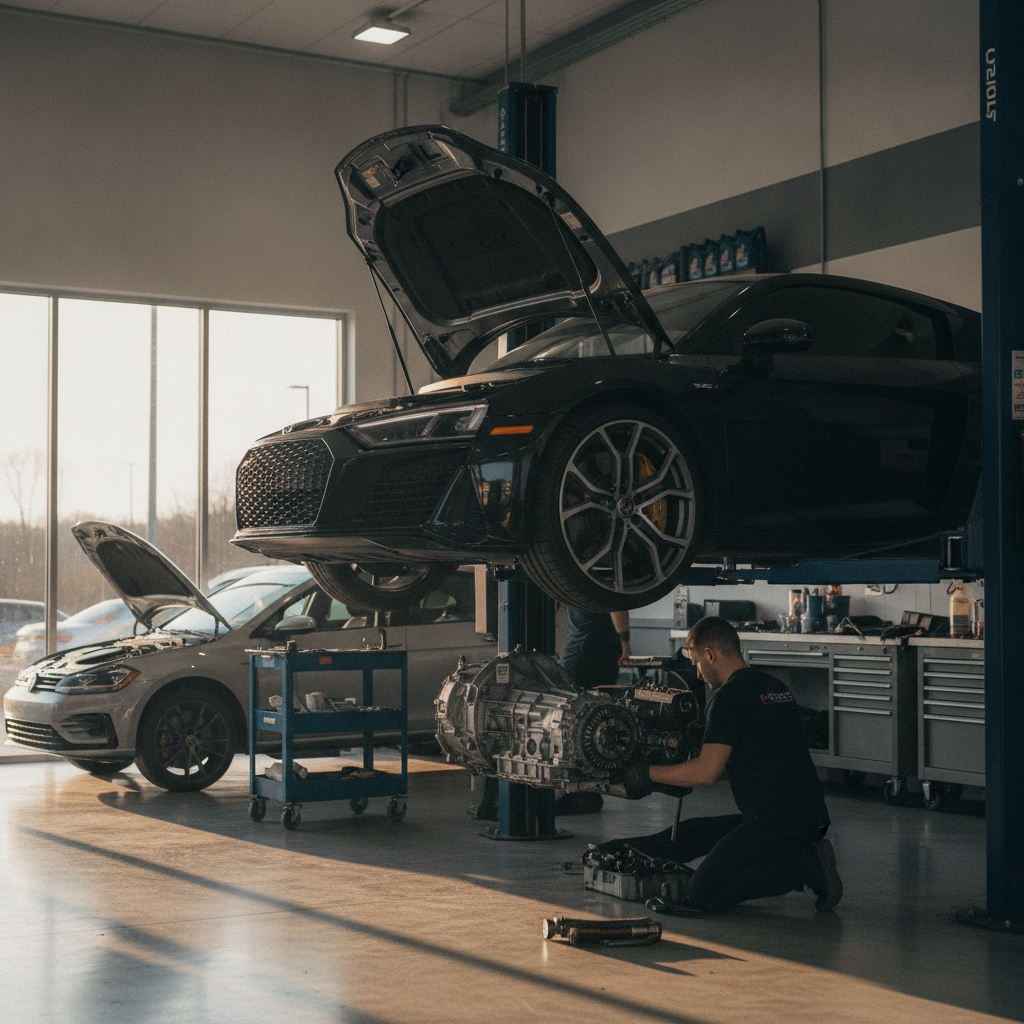
Why Is My Volkswagen or Audi’s DSG Transmission Slipping? What Peachtree Corners Owners Should Know
If your Volkswagen Golf, GTI, Tiguan, Audi A3, A4, Q5, or similar model is jerking when it shifts, hesitating at low speeds, or feeling like it’s hunting between gears, there’s a strong chance the DSG — Volkswagen’s Direct Shift Gearbox — is at the center of the problem. This isn’t a minor nuisance. A DSG transmission that’s slipping or shifting erratically is a system under mechanical stress, and for drivers in Peachtree Corners, Johns Creek, and throughout the GA-400 corridor, stop-and-go traffic makes the situation deteriorate faster than it would anywhere else. The good news is that most DSG problems are very fixable — but only if you bring them to someone who actually knows the transmission inside and out.
What Is a DSG Transmission and Why Is It Different?
The DSG is Volkswagen Group’s dual-clutch automatic transmission. Unlike a traditional torque-converter automatic, it uses two separate clutch packs — one for odd gears, one for even — allowing it to pre-select the next gear before you’ve even finished the current shift. The result is lightning-fast gear changes and better fuel efficiency than a traditional automatic. But that mechanical complexity also means there are more failure points, and the system is far more sensitive to fluid condition, software calibration, and clutch wear than a conventional gearbox.
There are two DSG variants you’ll encounter in VW and Audi vehicles: the DQ250 (six-speed, wet clutch) used in higher-torque applications, and the DQ200 (seven-speed, dry clutch) found in smaller-displacement models. They behave differently, fail differently, and require different diagnostic approaches. A shop that treats them interchangeably will miss things a trained European transmission specialist won’t.
The Most Common Reasons a DSG Slips or Jerks
When owners describe a DSG transmission problem, the symptoms usually fall into one of a few categories: a shudder or vibration during low-speed acceleration, a hard or delayed downshift, gear hunting in city traffic, or a lurch when engaging from a stop. Here’s what’s typically behind each of those:
- Degraded or contaminated DSG fluid: The DQ250 wet-clutch DSG runs its clutch packs in transmission fluid, and that fluid breaks down over time. VW originally marketed some intervals as sealed-for-life, but in real-world Atlanta traffic conditions, that’s simply not accurate. Degraded fluid causes clutch slip and shudder — often the first thing owners notice.
- Mechatronic unit failure: The mechatronic unit is the hydraulic and electronic control heart of the DSG. It manages clutch engagement pressure and shift timing. When it fails — often due to contaminated fluid reaching its solenoids — you get erratic shifts, hesitation, and fault codes that generic scan tools frequently misread.
- Dry-clutch wear (DQ200): The seven-speed dry-clutch DSG in smaller Audis and VWs is notoriously sensitive to driving style. Extended low-speed maneuvering, frequent reversing in parking lots, or the kind of stop-and-go driving you see between Norcross and Alpharetta every morning accelerates clutch wear on this unit significantly.
- Software and adaptation reset needed: The DSG’s transmission control module learns your driving habits over time. After fluid service, clutch replacement, or mechatronic work, the adaptation values must be reset and relearned using factory-level software. Skipping this step results in continued rough shifting even after the mechanical repairs are complete.
- Flywheel or dual-mass flywheel wear: On many VW and Audi DSG applications, the dual-mass flywheel is a wear item that contributes to shudder and vibration during engagement. It’s often overlooked at shops that aren’t familiar with the full drivetrain picture on these vehicles.
Why This Is the Gap Most Local Shops Miss
If you’ve searched for European transmission repair near Peachtree Corners or Roswell, you’ve probably noticed that most shops — including several competitors in the area — either give very generic information about transmission service or redirect you toward the dealership. That’s a telling sign. DSG repair requires OEM or OEM-equivalent diagnostic software (VCDS or factory VAG-COM tools), precise fluid specifications, and technicians who understand the difference between a DQ200 shudder on cold start and a DQ250 mechatronic fault. These are not the same repair, and they’re not treated the same way.
At Solo Motor Sports, our technicians are trained specifically on European drivetrain systems. We use factory-level diagnostic tools — the same capabilities the dealership uses — without the dealership markup. When we diagnose a DSG issue, we’re looking at live transmission data, fault memory, adaptation channels, and hydraulic pressure readings, not just pulling a code and guessing.
What Peachtree Corners and North Fulton Traffic Does to Your DSG
This is worth talking about directly, because local driving conditions are a genuine factor in how quickly DSG problems develop. The dry-clutch DQ200, in particular, was designed with European city driving in mind — slower speeds, more predictable traffic patterns. What it encounters instead is the Peachtree Parkway corridor, the backup at GA-400 heading north toward Alpharetta and Milton, or the crawl along Holcomb Bridge Road at peak hours.
In stop-and-go traffic, the dry clutch in a DQ200 DSG is constantly engaging and disengaging at low speeds — generating heat and wear that simply wouldn’t accumulate to the same degree on an open highway. If you’re commuting regularly through Norcross, Johns Creek, or into Sandy Springs, you should expect to service your DSG more frequently than VW’s original recommendations suggest, and you should have the system inspected at the first sign of low-speed shudder. Waiting until the problem is noticeable at highway speeds usually means you’ve already graduated from a fluid-and-adaptation service to something more significant.
DSG Service: What It Involves and What to Expect
A proper DSG service at a qualified European specialist includes more than a fluid drain-and-fill. Here’s what a thorough service should cover:
- Factory-spec fluid drain and refill with the correct DSG fluid (not a generic ATF — VW specifies G 052 182 for the DQ250 and G 052 171 for the DQ200, and substitutions cause damage)
- Filter replacement where applicable (DQ250 has an internal filter that must be replaced during fluid service)
- Fault code scan using VW/Audi-specific diagnostic software
- Transmission adaptation reset and relearn procedure
- Road test under controlled conditions to verify shift quality across all gear ranges
- Inspection of mechatronic unit condition and solenoid operation where fault codes indicate
If your vehicle needs mechatronic replacement, clutch pack work, or dual-mass flywheel service, that’s a more involved repair — but still one that can be completed at a specialist shop for significantly less than dealership rates, using OEM or OEM-equivalent parts with a warranty behind the work.
You can learn more about how we approach Volkswagen repairs and the full scope of drivetrain service we offer for VW and Audi vehicles at Solo Motor Sports.
Frequently Asked Questions: DSG Transmission Problems in Peachtree Corners and North Fulton
How often should I service my DSG transmission?
For most VW and Audi DSG-equipped vehicles driven in North Fulton or metro Atlanta traffic, every 40,000 miles is a reasonable interval for fluid and filter service on the DQ250. The DQ200 dry-clutch doesn’t use traditional fluid in the same way, but it still requires periodic inspection and adaptation checks. If you’re doing heavy city driving, lean toward the shorter end of that range.
Can I just reset the adaptation myself to fix the shudder?
You can initiate a basic adaptation reset with some aftermarket scan tools, but a proper DSG adaptation relearn requires factory software and a specific drive cycle procedure. Without the right tools and training, an incomplete relearn often makes the shudder worse. Bring it to a specialist who can verify the relearn completed correctly.
Is DSG repair covered under warranty?
If your vehicle is still under VW or Audi’s factory powertrain warranty, yes — bring it to the dealer for covered repairs. Once you’re out of warranty, an independent European specialist like Solo Motor Sports can perform the same repairs using OEM-quality parts and provide their own warranty on parts and labor, often at 20–30% less than dealer pricing.
My check engine light is on and my DSG is shifting rough. Are they related?
Almost certainly. Transmission control module faults, mechatronic solenoid codes, and clutch adaptation out-of-range errors all trigger the check engine or transmission warning light. A proper scan with VW/Audi-specific software will tell you exactly what the TCM is reporting — which is the only reliable way to know where to start the repair.
Is it worth repairing a DSG, or should I just trade the car in?
In most cases, a DSG repair is very much worth doing, especially on a well-maintained VW or Audi. A fluid and adaptation service is a relatively modest investment. Even a mechatronic replacement or clutch pack service is typically far less than the depreciation hit of trading the car, and a properly repaired DSG will last well past 150,000 miles with routine maintenance.
Ready to Get Your DSG Diagnosed?
If your Volkswagen or Audi is jerking, shuddering, hesitating, or throwing a transmission warning light, don’t wait for it to get worse. The DSG is a precision system — it responds well to early intervention and poorly to neglect. Solo Motor Sports serves owners throughout Peachtree Corners, Roswell, Alpharetta, Johns Creek, and across North Fulton County with the factory-trained expertise and diagnostic tools your vehicle deserves.
Contact us today to schedule a DSG diagnostic or transmission service appointment. We’ll give you a straight answer about what’s going on and what it will take to fix it — no upsells, no guesswork.